Category Archives: News

Autistic defendants are being failed by the criminal justice system

A survey of lawyers by the Autism Research Centre at the University of Cambridge has revealed that an overwhelming majority of their autistic clients were not provided with adequate support or adjustments

Researchers conducted a survey of 93 defence lawyers about autistic people they represented in the last five years, to find out about their defendants’ experiences of navigating the CJS. Lawyers from 12 nations were consulted, with the UK predominantly represented in the client sample.

The study revealed that:

  • Only half of autistic people (52%) were considered by the police to be vulnerable adults, even though UK law recognises all autistic people as vulnerable
  • Over a third (35%) of autistic defendants were not given an appropriate adult during police investigations, even though their diagnosis was known to police, and despite all autistic people being entitled under the law to have an appropriate adult present when being interviewed by the police
  • In just under half of the cases that included a trial by jury (47%), the jury was not informed that the defendant was autistic

The study follows an Equality and Human Rights Commission report in June 2020 that warned that the CJS is failing those with learning disabilities and autistic people.

Professor Sir Simon Baron-Cohen, Director of the ARC and a member of the research team, commented: “There’s an urgent need across the criminal justice system for increased awareness about autism. The police, lawyers, judges and jurors should be given mandatory training to be aware of how autism affects an individual’s behaviour, so that autistic defendants are treated fairly within the criminal justice system.”

Funding for the project was provided by the Autism Centre of Excellence.

As a national support network for autistic and neurodivergent police officers and staff, the NPAA advocates and shares best practice for police forces working with the autistic community, such as always providing autistic people with an appropriate adult in police custody.

Links for further reading:

Neurodiversity in Policing Conference 2021

Following our first national conference in 2020, the NPAA in partnership with the NPCC, College of Policing and Devon & Cornwall Police are hosting a second Neurodiversity in Policing Conference. This year’s event, themed “Think Different – Think Big”, is being run as a series of online presentations, talk cafés and workshops from the 16th to 30th November. Guest speakers include Matthew Syed, Margaret Heffernan and Vice Admiral Nick Hine.

The event is open to all NPAA members, police employees and volunteers, and staff from the wider criminal justice community. If you are an NPAA member, you should have already received an email about the event – details are available on our web forum (note you will need to be logged in to view the thread.)

If you are not a member and would like to be sent the conference programme and booking form, drop us a message via the contact page using the “Media/Comms & General” option. (Note that the conference is not open to members of public.) Alternatively, join us to get access to our members’ forum and/or regular email updates – it’s free and only takes a few minutes – simply fill in the form on the membership page with your details and work email address.

College of Policing releases workplace adjustments report

New discovery report outlines recommendations for improving diversity and inclusion in policing

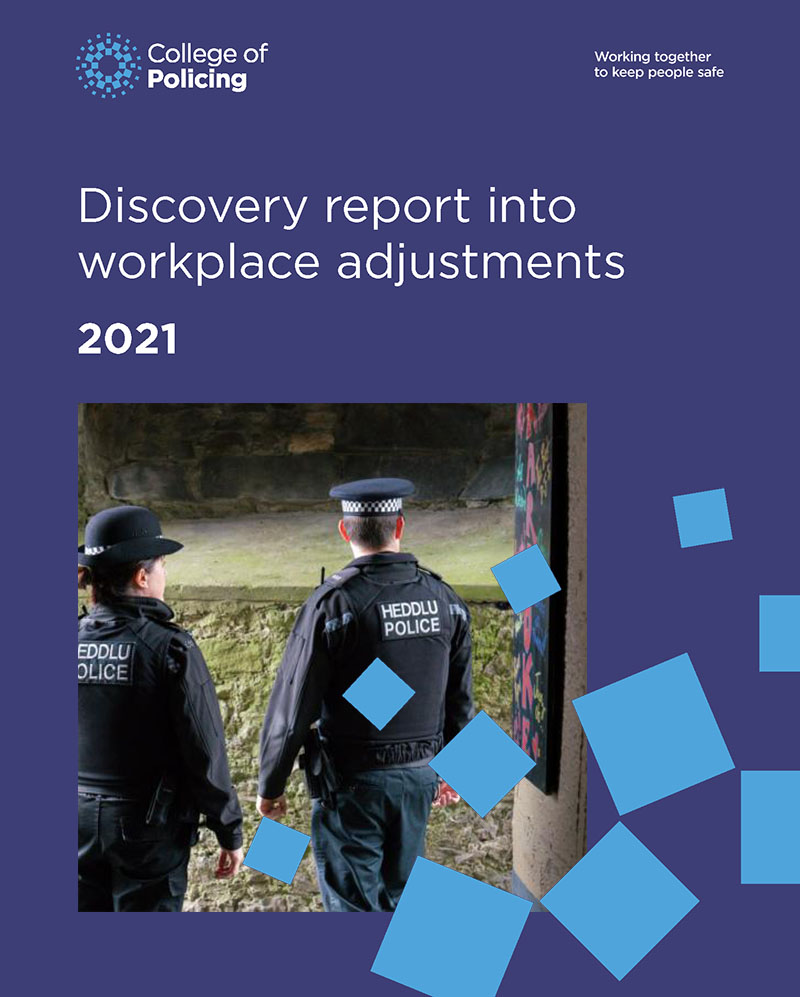
The College of Policing has released a discovery report on workplace adjustments (also known as reasonable adjustments) supporting disabled and neurodivergent officers and staff in the police service.

The report was commissioned by the National Police Chiefs’ Council (NPCC) as part of the Police Uplift Programme, the Government’s commitment to recruit an additional 20,000 officers by March 2023. Research was carried out by the College and PurpleSpace, the professional networking hub for disabled employees, with Force leads and individual officers and staff invited to participate in surveys run over the early part of 2021.

The report features quotations and personal stories, benchmarking studies from the public and private sector, and recommendations for change. Good practice by some police forces is highlighted, but the research also identifies a widespread lack of understanding of the importance of workplace adjustments in enabling disabled and neurodivergent staff to realise their potential. Key focus areas for improving inclusion across policing include strong leadership, effective employee networks, culture and language in relation to disability and neurodiversity.

A working group chaired by Deputy Chief Constable Amanda Blakeman, the NPCC’s lead for disability, is reviewing the recommendations. DCC Blakeman said: “Our colleagues’ stories show us that simple adjustments can make a huge difference, empowering individuals to give their best and helping forces to build strong inclusive teams that are reflective of our communities.”

Some key takeaways from the individuals, HR business partners and diversity leads taking part in the survey:

  • 25 police forces had achieved Disability Confident Level 2 accreditation, with a further five Forces and the College of Policing achieving the top Level 3 tier (Disability Confident Leader)
  • 45% of Force Diversity & Inclusion strategies made reference to neurodiversity
  • 53% of HR departments were confident in the ability of first and second line managers to have proactive and inclusive conversations with their staff about disability
  • 69% of individuals had personally experienced, or were aware of a colleague having experienced, refusal of a reasonable adjustment request

Click on the image above to view the report page on the College of Policing website and download the PDF (133 pages). (A 3 minute video summary of the key points is available from Rank Success.)

The NPAA would like to thank the College of Policing and NPCC for the opportunity to participate in this project. ∎